
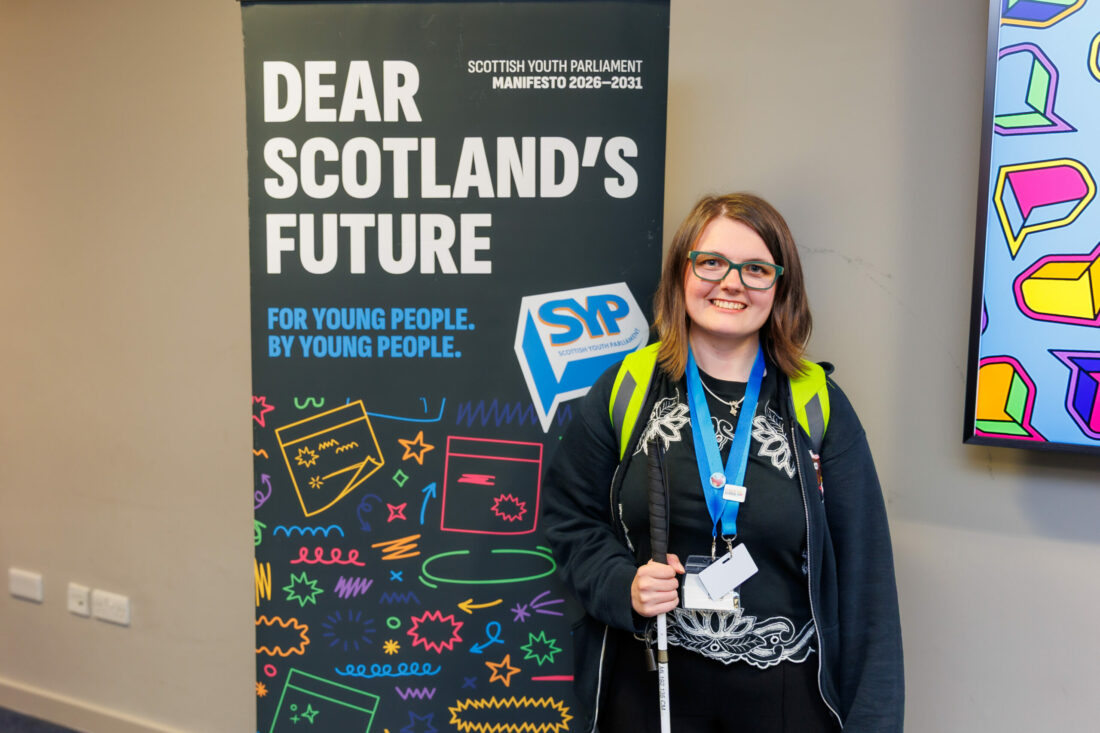
Hello, I am Eilidh Morrison. I have a rare condition called Joubert Syndrome – I am visually impaired and have Retinitis pigmentosa and ocular motor apraxia.
Last year, I embarked on a new adventure: A postgraduate diploma in education (PGDE) for primary school after completing my undergraduate degree in Physics. Alongside my studies, I have been an MSYP, representing Haggeye for the last seven years (during which I have been dedicated to representing my visually impaired community).
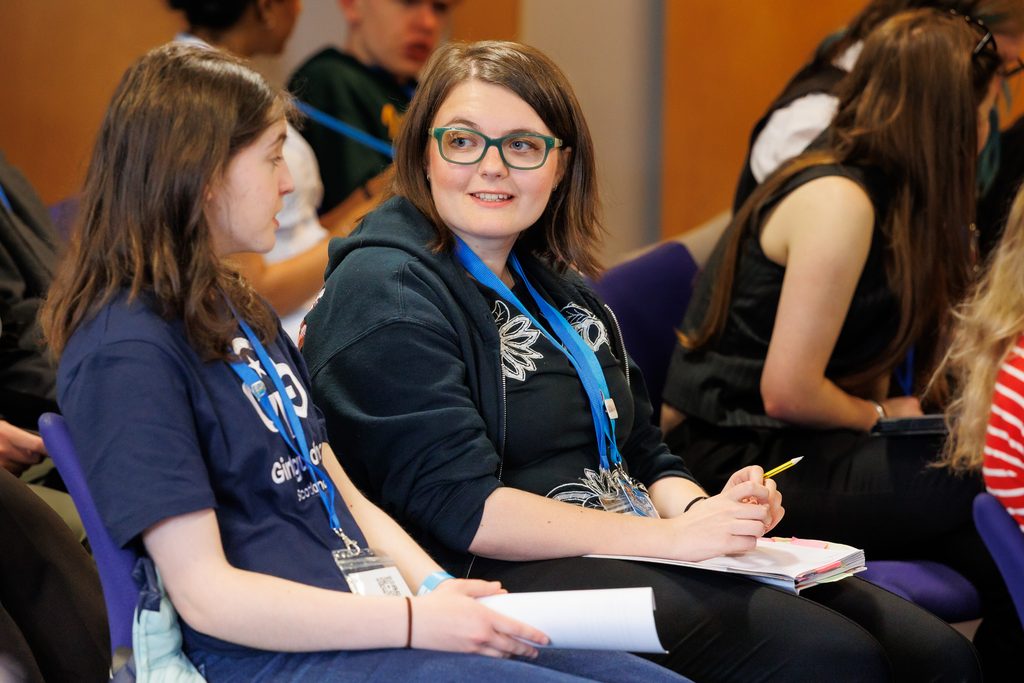
In 2023, I joined the Screensavers – SYP’s Mind Yer Time project group. Mind Yer Time is a digital wellbeing project created by the Children’s Parliament and SYP. The project is unique because children and young people across Scotland shape it directly. It aims to help young people use screens and social media in healthy, positive ways, without judgement or fear‑based messaging. For me, Mind Yer Time offered something even more valuable: a space where visually impaired voices could be heard in conversations about digital wellbeing, accessibility, and online safety.
I joined the project for two reasons: First, I wanted to advocate for accessibility. Too often, digital platforms overlook the needs of blind and partially sighted users. I wanted to be the person who could confidently say: “This is not accessible,” and explain why. Mind Yer Time allowed me to highlight the barriers visually impaired young people face online, from unreadable text to cluttered interfaces and inaccessible safety features.
Second, I joined for personal reasons. Growing up, online safety was never taught in depth at school, and certainly not in a way that considered disability. As someone in a vulnerable group, I wanted to learn how to protect myself online, set boundaries, and recognise risks that might be harder to detect with limited sight.
During my ten‑week placement in Primary Seven, I discovered just how powerful the Mind Yer Time website can be as a teaching tool. Digital wellbeing is an area many teachers want to address, but it can feel overwhelming — especially when pupils are already using platforms, apps, and games that adults may not be familiar with. What Mind Yer Time offers is a way into these conversations that feels manageable, accessible, and genuinely pupil‑friendly. It removes the pressure to be an expert in every app or trend and instead gives teachers a structured, youth‑led resource that pupils immediately connect with.
I used Mind Yer Time to deliver a sequence of lessons on screen time, digital habits, and online behaviour. What made the biggest difference was how easy it was to integrate into my planning. The language is clear, the topics align naturally with Curriculum for Excellence digital literacy outcomes, and the activities are flexible enough to adapt for different ages and abilities. Teachers don’t need specialist training or additional materials — everything is already there, ready to use. This simplicity is what makes the resource so empowering: It allows teachers to focus on discussions, reflections, and relationship‑building rather than spending hours preparing content.
The pupils responded incredibly well to the youth‑led nature of the site; they recognised themselves in the stories, the scenarios, and the swipe‑cards, which made them more willing to share their own experiences. Instead of feeling lectured about screen time, they felt invited into a conversation. As a teacher, this shifted the dynamic in the classroom. I wasn’t policing their digital lives — I was supporting them to make informed choices. Mind Yer Time helped me create a safe, open environment where pupils could talk honestly about gaming, group chats, social media pressure, and online kindness.
One moment that really stayed with me came after a lesson on screen time. A P7 pupil approached me the next day and said, “I went home and checked how much screen time I use — and I was shocked.” That simple reaction showed me just how quickly pupils begin to reflect when they are given the tools and language to understand their digital habits. It wasn’t about telling them off or restricting their devices; it was about helping them recognise patterns and make their own informed choices. Moments like this remind teachers that digital wellbeing doesn’t require complicated interventions — sometimes all it takes is a clear conversation and a resource that speaks directly to young people’s experiences.